Why September and October Are Two of the Best Months to Travel To Croatia?
Peak summer isn't the only smart pitch. Here's why September and October give your Croatia clients better weather, fewer crowds, and richer experiences.

Private Yacht Charter in Croatia Around $50,000: What Can Your Client Expect?
What does $50,000 a week actually get your client in Croatia? Here's the honest breakdown of budget, boat, crew, and who this charter tier really suits.
Via Croatia·Sep 25, 2026A client hears a number like $50,000 a week and reacts one of two ways. Either it sounds like far more than a boat should cost, or it sounds surprisingly reasonable for a private yacht in the Mediterranean. Neither reaction tells you much, because the number on its own doesn't mean anything until it's attached to an actual vessel, an actual crew, and an actual week on the water.
Around $50,000 a week sits at a very specific, well-defined tier in Croatia's charter market, and it's worth understanding precisely what that tier includes before you put it in front of a client. Here's the honest breakdown of budget, boat, crew, and features at this price point, and who it actually suits.
This is the question to answer before any other, because the base charter rate is only part of the total cost, and a client who isn't warned about that upfront tends to feel blindsided later rather than delighted. Croatia applies a 13% VAT to charter fees, and it's typically added on top of the advertised rate rather than baked into it. On a $50,000 base, that's an additional $6,500 before anything else is factored in.
Then there's the Advance Provisioning Allowance, commonly referred to as APA, which covers fuel, food, drinks, docking fees, and other variable costs incurred during the week. APA typically runs somewhere between 25% and 30% of the base charter rate, so on a $50,000 booking, a client should budget roughly another $12,500 to €15,000 for this alone. Add gratuities for the crew, usually somewhere in the range of 10% to 15% of the base rate, and a client's real total for a $50,000 base charter often lands closer to $70,000 once everything is accounted for.
None of this is unusual or a red flag, it's simply how yacht charters are priced across the world. The advisors who present this breakdown clearly and early are the ones whose clients don't feel surprised by the final invoice.
A simple way to frame it for a client is to present two numbers from the start: the base charter fee, and a realistic all-in estimate that already includes VAT, APA, and gratuities. Clients who hear only the base rate tend to anchor on that figure mentally, which makes the eventual full invoice feel like a surprise even when nothing about the pricing was unusual. Clients who hear both numbers upfront tend to book with far more confidence, because there's nothing left to discover later.
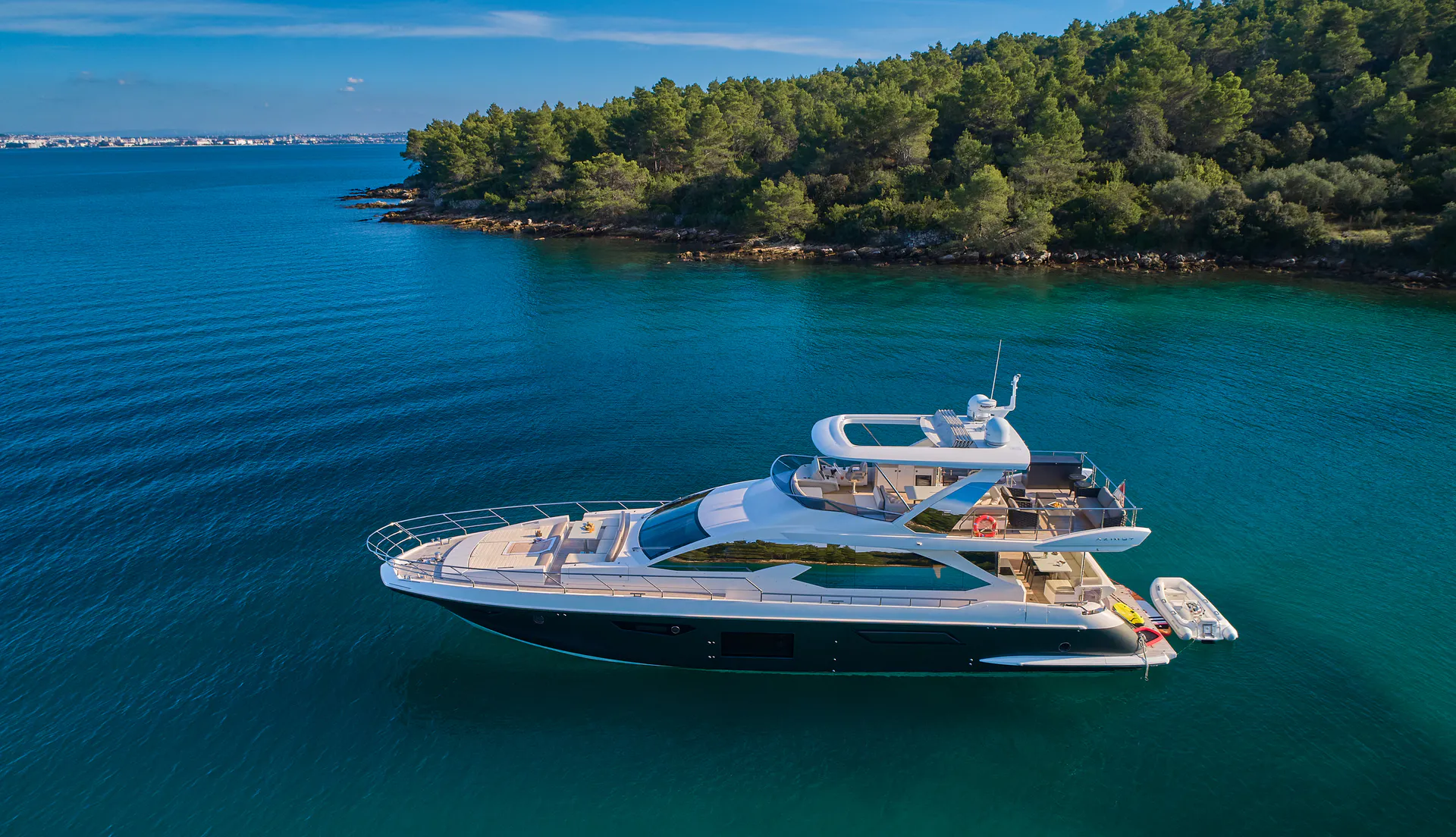
At this price point, a client should expect a premium motor yacht in the 70 to 80 foot range, typically with four cabins accommodating up to eight guests. Azimut 78 in Via Croatia's fleet, sits right in this tier. She offers a full-beam flybridge, a foredeck sun lounge, and a proper aft dining area, the kind of layout that makes eight guests feel comfortable rather than crowded.
This tier sits in the middle of Via Croatia's range rather than at either end. A step down, a vessel like the Azimut 72 Fly, brings the same eight-guest capacity at a noticeably lower rate, around $27,350 a week, with a slightly more intimate feel and a smaller crew of two.
A step bigger and with more cabins, S/Y Corsario moves into an entirely different category, a 48-meter sailing superyacht for up to 12 guests at closer to $90,000 a week, with a much larger crew and a broader range of onboard amenities.
Knowing where $50,000 sits relative to those neighbors helps a conversation move quickly once a client's budget is confirmed, since it's often easier for a client to place themselves on a spectrum than to evaluate a single number in isolation.
A yacht at this tier typically carries a crew of two to three, usually a captain and a deckhand or stewardess, sometimes with a dedicated chef included depending on the vessel. That's a meaningfully smaller team than a large crewed superyacht, and it's worth setting that expectation honestly rather than letting a client assume the service level of a 12-person crew on an 8-guest boat.
What that smaller crew delivers is still genuinely personal. Meals are prepared and served on board, the crew handles docking, provisioning, and route planning, and the guest experience remains attentive throughout the week. It's simply a more compact version of full-service charter, well matched to a group of six to eight rather than the larger production a 30-guest cruiser requires.
A yacht in this range typically comes with a tender for shore transfers, snorkeling gear, paddleboards, jet ski, sea-bobs, e-foils and often a stabilizer system that keeps the ride comfortable even when the water isn't perfectly flat. The flybridge usually doubles as the best social space on board, and an aft dining area handles meals with a view rather than squeezed below deck.
What a client shouldn't expect at this level is the full water-park lineup that shows up on larger vessels, a waterslide, a dedicated sauna. That's not a shortfall, it's simply a different tier of the market. A client whose priority is a comfortable, well-appointed boat with the essentials done well tends to be genuinely satisfied here. A client who's set their heart on a waterslide or an onboard gym needs a larger, higher-tier vessel instead, and it's worth having that conversation before booking rather than after.
Season matters more at this tier than clients often assume. During peak July and August weeks, $50,000 sits closer to the entry point of what's realistically available, and the best boats in this range book up early, sometimes months ahead of the season. A client working with a tight budget in peak season may need to be flexible on exact dates or consider a slightly smaller vessel to stay within range.
Move into September or October, and the same budget stretches noticeably further. Demand drops, availability opens up, and a client can often secure a better vessel, a better week, or simply more flexibility for the same money. If a client's dates aren't locked to summer specifically, pitching the shoulder season alongside this budget conversation is often the easiest way to get more boat for the same investment.
This tier suits couples and small groups of friends or family, typically up to eight guests, who want a genuine private yacht experience without moving into superyacht territory. It's also a strong fit for a client taking their first serious yacht charter, someone who wants to understand what a private boat actually feels like before committing to a larger, more expensive vessel on a future trip.
Think of it as a real stepping stone rather than a compromise. A client who charters at this level and loves it is often the same client who comes back in a year or two ready for a Corsario-scale experience, having already learned what they value most about being on the water.
It's also a genuinely good fit for a client who's chartered abroad before, in the Caribbean or elsewhere in the Mediterranean, and wants to bring that same standard to Croatia specifically without necessarily scaling up in size. That client already understands what a private yacht offers, so the conversation moves faster than it would with a true first-timer, and the focus shifts quickly to route and itinerary rather than convincing them of the concept itself.
Start with the guest count and how those guests actually need to sleep, since four cabins can work very differently for four couples than for a family with kids and grandparents. Confirm whether the client's stated budget is the base charter fee alone or intended to cover the full trip including VAT, APA, and gratuities, since that single clarification prevents most pricing confusion down the line.
Ask how central time on the water actually is to what the client wants from the trip, and how much they care about onboard toys and activity versus simply having a comfortable, well-run boat. Confirm the itinerary style they're picturing, constant island-hopping versus a slower pace with more time in fewer places, and lock down their travel dates early, since season affects both price and availability more than almost anything else at this tier.
$50,000 a week gets a client a genuinely comfortable, well-crewed private yacht for up to eight guests, once VAT, APA, and gratuities are factored honestly into the total. It's not the entry point of the market, and it's not the top of it either, it's a specific, well-defined tier that suits a specific kind of client extremely well.
If you have a client asking what a budget like this actually gets them, schedule a discovery call with our team and we'll walk through the real numbers together. We'll help you match their budget to the right vessel in our yacht fleet, whether that's this tier specifically or something a step in either direction, so the number you give them upfront is the number they actually see at the end.
Take a look at some articles with similar topics that you might find interesting.
Why September and October Are Two of the Best Months to Travel To Croatia?
Peak summer isn't the only smart pitch. Here's why September and October give your Croatia clients better weather, fewer crowds, and richer experiences.
Land or Yacht? Why the Best Croatia Trips Often Combine Both
Land gives your clients depth. The sea gives them freedom. Here's why the strongest Croatia itineraries stop choosing between the two.
Who Is the Perfect Private Yacht Client? A Qualifying Guide for Travel Advisors
Not every client belongs on a yacht. Here's how to recognize the ideal private yacht charter client and confidently pitch the right ones.