Symphony: Who Is This 30-Guest Croatia Cruiser Yacht Best For?
A 30-guest yacht solves problems smaller charters can't. Here's who Symphony is really built for, and how to position her to the right client.

The Best Croatia Itinerary: 10 Days From Zagreb to Dubrovnik
Looking for the best Croatia itinerary? This iconic 10-day journey covers 4 UNESCO sites, truffle hunting in Istria, private sailing on Hvar, and Dubrovnik's city walls. From $11,848 per person.
Via Croatia·Aug 4, 2026Croatia is a country that rewards depth more than distance. Its coastline stretches nearly 1,800 kilometres. Its interior holds waterfalls, hilltop villages, and Roman ruins that most visitors never reach. Its islands each have their own character, their own wine, and their own reasons to stay longer than planned.
Ten days is the window where a Croatia trip stops feeling like a highlights reel and starts feeling like a real journey. Enough time to begin in Zagreb and actually understand why the capital is worth two nights. Enough time to move slowly through Istria and Plitvice rather than ticking them off. Enough time to reach the Dalmatian coast with the energy to appreciate it rather than arriving exhausted.
This is best-selling itinerary for a reason. Seventeen locations, four UNESCO World Heritage Sites, one private sailing day, a truffle hunt in the Motovun Forest, fresh oysters in Mali Ston Bay, and a finale in Dubrovnik that earns every superlative ever written about it. Here is what the ten days look like.
Most travelers arrive in Zagreb expecting a transit point. A city to pass through before reaching the coast. What they find instead is a genuinely captivating European capital with a Austro-Hungarian grandeur, a café culture that rivals Vienna, and a food scene that has grown considerably more confident over the past decade.
The Upper Town offers the Church of St. Mark with its tiled roof, the Lotrščak Tower, and cobbled streets that are quieter and more characterful than almost anything on the Dalmatian coast in summer. The Lower Town's museums, the Dolac market, and the Tkalčićeva street café strip fill out a first day that consistently surprises guests who arrived with low expectations. Zagreb is the part of Croatia that most visitors wish they had given more time to. Two nights here is the right call.
Day two is the one that sets the tone for the entire itinerary. After a private guided tour through Zagreb's historic streets, the afternoon moves to a wine tasting at a Michelin-starred winery, followed by a fine dining lunch with regionally inspired dishes. This is not a standard wine tour. It is a curated introduction to Croatian gastronomy at its most considered, in a setting that reflects the best of what the country's wine culture has become. Clients who arrive thinking of Croatia as a beach destination leave Day 2 understanding it as something considerably more layered.
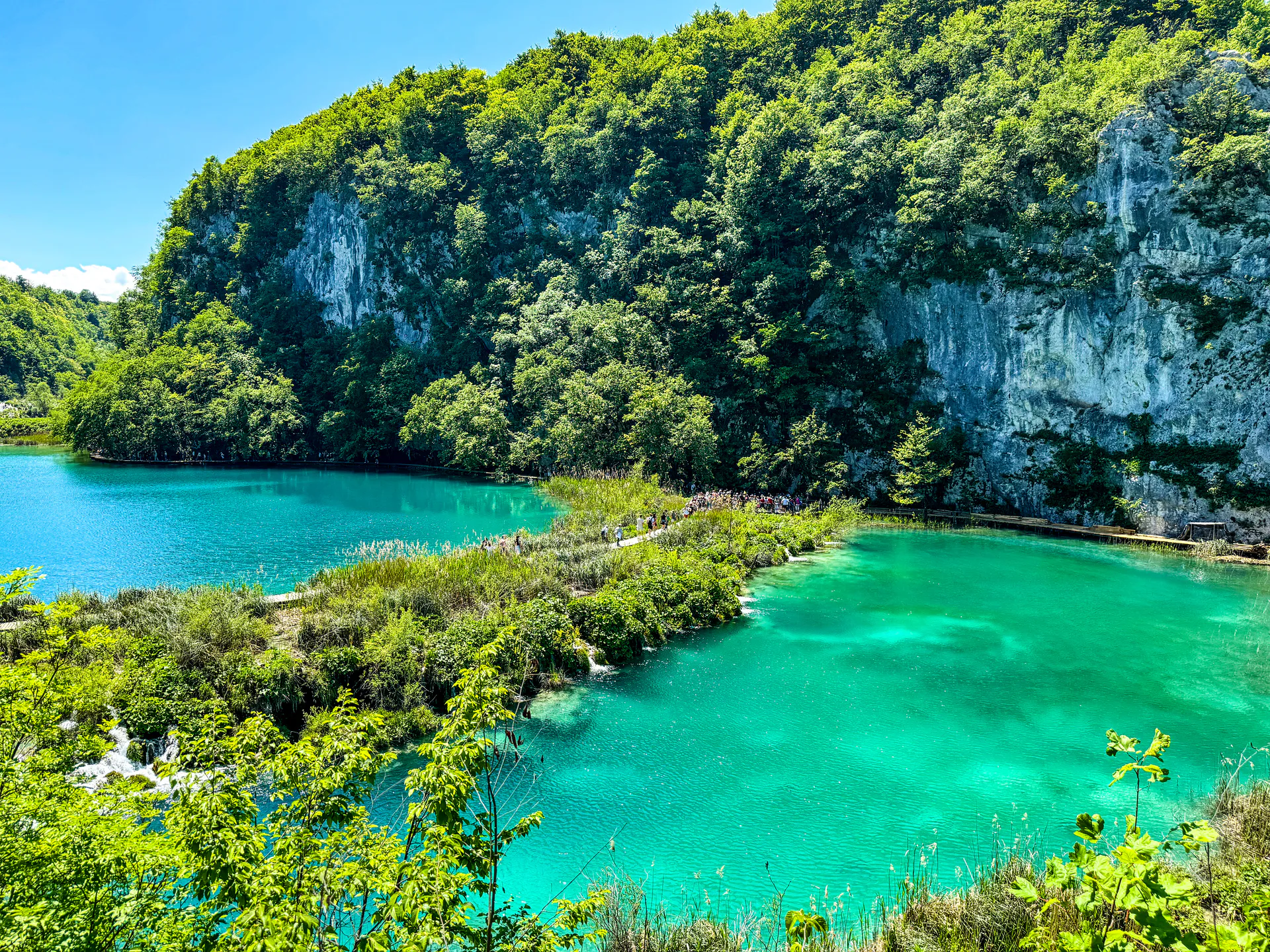
Unequivocally yes, and the numbers confirm it. Plitvice Lakes National Park attracted nearly 1.5 million visitors in 2024, making it the most visited national park in Croatia and one of the most visited natural sites in Europe. It has been a UNESCO World Heritage Site since 1979, recognised for its extraordinary karst geology: 16 cascading lakes separated by natural travertine dams, formed over millennia by the flow of calcium-rich water over limestone. The result is a landscape of waterfalls, crystal-clear pools, and dense forest that shifts colour constantly depending on the minerals in the water and the angle of the light.
The challenge is experiencing it properly rather than just experiencing it. Via Croatia's private guide times the visit to avoid the peak midday crowds, taking guests through the most scenic boardwalk trails in the early part of the day before the main visitor flow arrives. The electric boat crossing of Kozjak Lake and the panoramic train between circuits are included. With a guide who knows the park's quieter corners, Plitvice becomes the morning that most guests name as one of the unexpected highlights of the trip.
The day begins in Rastoke, a village where two rivers converge in a tangle of watermills, wooden houses, and small cascades that form a natural garden of falling water. Less than an hour from Plitvice, Rastoke is a place that most itineraries skip entirely. It sets the right mood for the day that follows and gives guests something genuinely unexpected before the park itself.
Day four is the one that travels home with guests as a story. The Motovun Forest in central Istria is one of the most important truffle habitats in Europe, with the quality of the white truffle found here considered equivalent to the celebrated varieties from Piedmont. A private truffle hunt with a renowned local family involves a walk through the forest with trained dogs, a tasting of truffle liqueur on site, and a three-course truffle feast paired with local wines. The afternoon continues to the medieval hilltop towns of Motovun and Grožnjan, two of Istria's most beautiful villages, both quiet enough by mid-afternoon to feel entirely personal.
This is the experience that most clearly demonstrates what Via Croatia does differently. No search engine can surface a private family truffle hunt followed by a feast in their home. It exists through years of local relationships and genuine trust with the people who make this kind of access possible.
Day five moves to the Istrian coast. Pula's Roman amphitheatre, one of the six largest surviving Roman arenas in the world, built in the first century AD and still hosting concerts today, is a site that consistently stops visitors. The scale and the completeness of it, standing in a city centre rather than isolated as a ruin, makes it one of the most compelling ancient structures in the Mediterranean.
From Pula, the route continues to Rovinj, one of Istria's most photogenic coastal towns. The Batana Eco-Museum visit and a traditional flat-bottomed boat ride on the water introduce the town's fishing heritage. A gourmet dinner with local wines and live music closes the day in a way that Rovinj at golden hour, its pastel-coloured houses reflected in the harbour, consistently earns.
One full day is the minimum; two days is better. Split is Croatia's second city and the gateway to the Dalmatian islands, but its most distinctive feature is the old town itself: built inside and around Diocletian's Palace, a Roman imperial complex constructed at the end of the third century AD and listed as a UNESCO World Heritage Site in 1979. Roughly 3,000 people still live and work within its ancient walls, making it the most continuously inhabited Roman palace in the world.
A private guided walk through the palace's underground cellars, the Peristyle, the Cathedral of Saint Domnius (built inside the emperor's own mausoleum), and the lesser-known gates delivers layers that most visitors walk straight past. The day then continues to the Sikuli winery outside the city for a multi-course food and wine pairing among the vineyards. History in the morning, Dalmatian terroir in the afternoon: this is how a day in Split should work.
Day seven is the sailing day, and for many guests it is the one that confirms why Croatia is unlike anywhere else in the Mediterranean. A private luxury boat departs Split for Hvar, one of the most celebrated islands on the Adriatic coast. The morning includes guided sightseeing in Hvar Town, with its Venetian square and fortress, before the afternoon opens onto the Pakleni Islands: a loose archipelago of pine-covered islets with sheltered bays accessible only by private boat.
A swim stop in Palmižana Bay, a visit to the Laganini Beach Club, and a scenic cruise back to Split close a day that consistently ranks as the highlight of the trip in guest feedback. Hvar also holds Croatia's most ancient winemaking heritage: the Stari Grad Plain, inscribed as a UNESCO World Heritage Site in 2008, has been farmed continuously since Greek colonists planted the first vines in 384 BC. The private boat makes it possible to touch three of the itinerary's four UNESCO sites in a single afternoon.
Day eight travels the Dalmatian coast south from Split toward Dubrovnik, with one essential stop along the way. Mali Ston Bay, on the Pelješac Peninsula, has been farming the European flat oyster since Roman times. The bay's unique combination of Neretva freshwater and the mineral-rich Adriatic produces an oyster of exceptional quality, widely regarded as the finest in the Mediterranean. A boat tour of the historic oyster farms with fresh tastings and local wine, followed by lunch at the famed Bota Šare, is one of the simplest and most memorable food experiences available anywhere on the Croatian coast.
From Mali Ston, the route continues to Dubrovnik, where the old town reveals itself through the city gate and the effect is immediate: the limestone streets, the Stradun promenade, the walls above the sea. A guided walk of the city walls and its key landmarks closes the day with the kind of arrival that Dubrovnik has been delivering for centuries.
Day nine is the final water day. A private motor boat departs Dubrovnik and passes the Elaphite Islands, the forested island of Mljet, and the Pelješac Peninsula before arriving at Korčula. The medieval old town, with its streets laid out in a deliberate fishbone pattern and its cathedral dating to the 15th century, is one of the best-preserved historic towns in Dalmatia. A local guide leads the walk through Korčula's key sites, including St. Mark's Cathedral and the Marco Polo house, before the afternoon opens up for swimming, bay-hopping, or simply drifting along the coast at whatever pace suits the group.
The short answer is that this itinerary is a starting point, not a fixed script. We describe our approach as "made to measure," meaning every element can be adjusted before the trip begins. If your clients want to spend an extra day in Istria, extend the sailing chapter, add a private winery visit on Pelješac, or replace an activity with something more personal to their interests, the itinerary reshapes around them. The pricing is a starting point based on the curated sample. The final trip reflects the specific people who are taking it.
Every property has been personally visited by the our team. Every guide is chosen for their character and depth of knowledge as much as their professional credentials. Every transfer uses premium, late-model vehicles with professional chauffeurs. The logistics happen entirely behind the scenes. What clients experience is seamless.
The best Croatia itinerary is not the one that covers the most ground. It is the one that gives each destination enough time to reveal something worth remembering. Zagreb as a capital that earns two nights. Plitvice as a morning of genuine stillness rather than a rushed circuit. Istria as a full chapter rather than a single day. The Dalmatian coast as a sequence of experiences that build on each other, ending in Dubrovnik at the moment the itinerary has earned it.
Seventeen locations. Four UNESCO sites. One private sailing day. One truffle hunt. One oyster farm by boat. One Michelin wine journey. Ten days that show Croatia in full.
Take a look at some articles with similar topics that you might find interesting.
Symphony: Who Is This 30-Guest Croatia Cruiser Yacht Best For?
A 30-guest yacht solves problems smaller charters can't. Here's who Symphony is really built for, and how to position her to the right client.
7 Croatia Experiences Your Clients Won't Find on a Typical Booking Site
Seven real Via Croatia experiences, from a private dinner on Dubrovnik's walls to a Michelin chef's picnic near Plitvice, that no booking site can replicate.
5 Things to Do in Croatia That Go Beyond a City Tour
Skip the crowded checklist. Here are 5 real Croatia experiences, from private yacht days to a truffle hunt in Istria, that go far beyond a standard tour.